
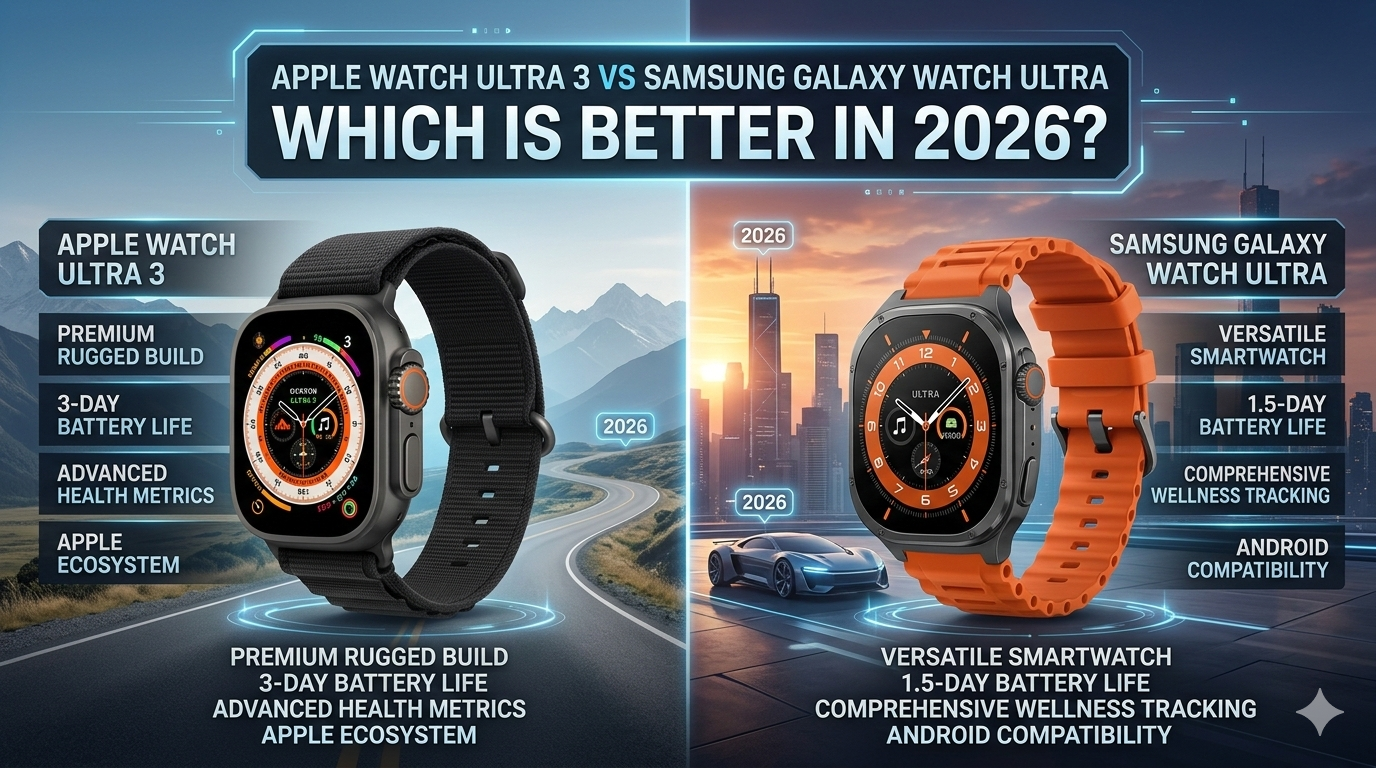
The Apple Watch Ultra 3 vs Samsung Galaxy Watch Ultra showdown is the biggest premium smartwatch rivalry of 2026. Apple’s flagship starts at $799 with 5G and satellite connectivity, while Samsung’s refreshed Ultra holds at $649 with marathon battery life and deeper water resistance. Both feature titanium cases, sapphire crystals, and serious fitness tracking. This guide breaks down the Apple Watch Ultra 3 vs Samsung Galaxy Watch Ultra across every category that matters so you can pick the right rugged smartwatch for your wrist.
Table of Contents
Apple Watch Ultra 3 vs Samsung Galaxy Watch Ultra: The 2026 Verdict
Choosing between the Apple Watch Ultra 3 vs Samsung Galaxy Watch Ultra isn’t about which watch has better specs on paper. It’s about which one fits your phone, your lifestyle, and your budget. iPhone owners get the most polished experience with Apple’s Ultra 3, while Android users finally have a genuinely premium competitor in Samsung’s Galaxy Watch Ultra. If you’re switching ecosystems or buying your first high-end smartwatch, here’s everything you need to know before spending $650 to $800.
Apple Watch Ultra 3: The iPhone Athlete’s Choice

Apple Watch Ultra 3
- 49mm Grade 5 titanium case with sapphire crystal
- Always-on Retina LTPO3 OLED display (up to 3,000 nits)
- Apple S10 SiP with neural engine
- Up to 42 hours battery (72 hours in Low Power Mode)
- 100m water resistance, 40m recreational scuba diving
- Built-in 5G cellular and satellite connectivity
The Apple Watch Ultra 3 is the premium pick for iPhone users in this matchup. Apple bumped the battery to 42 hours in standard mode, a meaningful upgrade from the Ultra 2’s 36 hours. The 49mm titanium case is rugged enough for trail running and backcountry skiing, while the sapphire crystal shrugs off scratches that would destroy standard watch glass. The biggest new addition is satellite connectivity paired with 5G, meaning you can send emergency SOS messages even without cell service. The S10 chip runs watchOS 12 smoothly, though it’s essentially the same silicon as last generation. At $799, this is by far the more expensive option in the Apple Watch Ultra 3 vs Samsung Galaxy Watch Ultra comparison, and you still need an iPhone to use it. But if you’re already in Apple’s ecosystem, nothing else comes close to the integration you get with your iPhone, AirPods, and Mac.
Samsung Galaxy Watch Ultra: The Android Powerhouse
Samsung Galaxy Watch Ultra (2025)
- 47mm titanium case with sapphire crystal
- 1.5″ Super AMOLED display (up to 3,000 nits)
- Exynos W1000 3nm processor
- Up to 100 hours battery (power saving mode)
- 10ATM water resistance (100m), IP68, MIL-STD-810H
- 64GB storage, LTE connectivity included
Samsung’s Galaxy Watch Ultra is the strongest Android answer to Apple’s dominance. The 2025 refresh kept everything that worked — the titanium build, 100-hour battery ceiling, and 100-meter water resistance — while doubling internal storage to 64GB and adding a new Titanium Blue colorway. The 3nm Exynos W1000 chip keeps things snappy on One UI 8 Watch (Wear OS 6), and the 1.5-inch Super AMOLED now matches Apple at 3,000 nits peak brightness. At $649, it undercuts the Apple Watch Ultra 3 by $150, which is significant for buyers who want premium hardware without the Apple tax. The rotating physical bezel remains a standout navigation feature. The catch? Samsung’s smartwatch app ecosystem still trails Apple’s, and the experience is best on Samsung Galaxy phones specifically. If you use a Pixel or other Android device, expect slightly less seamless integration.
Full Spec Comparison Table
| Feature | Apple Watch Ultra 3 | Samsung Galaxy Watch Ultra |
|---|---|---|
| Display | ~2″ LTPO3 OLED (slimmer bezels) | 1.5″ Super AMOLED |
| Brightness | Up to 3,000 nits peak | Up to 3,000 nits peak |
| Processor | Apple S10 SiP | Exynos W1000 (3nm) |
| Standard Battery | Up to 42 hours | 2–3 days typical use |
| Max Battery (Power Save) | 72 hours (Low Power Mode) | 100 hours |
| Water Resistance | 100m rated, 40m scuba diving | 10ATM (100m), IP68 |
| Case Material | Grade 5 titanium, sapphire crystal | Titanium, sapphire crystal |
| Storage | 64GB | 64GB |
| Connectivity | 5G cellular + satellite | LTE cellular |
| Operating System | watchOS 12 | One UI 8 Watch (Wear OS 6) |
| Durability | IP6X dust resistance | MIL-STD-810H, IP68 |
| Weight | 61.7g | 60.5g |
| Price (2026) | From $799 | From $649 |
| Best For | iPhone users, satellite safety | Android users, battery longevity |
Deep Dive: How They Compare Category by Category
Display Quality
Both watches now hit 3,000 nits peak brightness, eliminating the gap that existed between the Ultra 2 and original Galaxy Watch Ultra. Apple’s display is physically larger at roughly 2 inches versus Samsung’s 1.5 inches, which makes reading maps, messages, and workout metrics easier at a glance. Apple also trimmed the bezels on the Ultra 3, so you get more screen in the same 49mm case. Samsung counters with a vibrant Super AMOLED panel and 480×480 resolution that looks sharp despite the smaller footprint. For outdoor readability, they’re now essentially tied. For screen real estate, Apple wins.
Battery Life: Samsung’s Multi-Day Advantage
Battery life is the category where the Apple Watch Ultra 3 vs Samsung Galaxy Watch Ultra gap is most dramatic. Samsung delivers up to 100 hours in power-saving mode, translating to roughly four days of mixed use without touching a charger. Apple improved to 42 hours standard and 72 hours in Low Power Mode, a solid upgrade from the Ultra 2 but still well behind Samsung’s endurance. For multi-day backpacking trips, ultramarathons, or anyone who hates nightly charging, Samsung’s battery advantage is hard to ignore. Apple does offer faster charging — 80% in 45 minutes — which partially offsets the shorter runtime.
Fitness and Health Tracking
Both watches cover the basics thoroughly: heart rate monitoring, blood oxygen, ECG, sleep tracking, and workout detection. If you’re also shopping for tech accessories alongside your new smartwatch, check out our guide to the best months for deals on electronics to time your purchase for maximum savings. Apple added hypertension alerts on the Ultra 3, a meaningful health feature for users monitoring blood pressure trends. Samsung counters with body composition analysis, AGEs index tracking, and sleep apnea monitoring through its BioActive sensor. For runners, Apple’s integration with the Fitness app and third-party apps like Strava remains smoother. Samsung offers a dedicated Running Coach feature and more granular workout customization through One UI. This category is a genuine tie — Apple wins on ecosystem polish, Samsung wins on sensor variety.
Durability and Water Resistance
Both watches carry 100-meter water resistance ratings, but the details differ. Apple rates the Ultra 3 for recreational scuba diving to 40 meters under ISO 22810, while Samsung’s 10ATM rating with IP68 and MIL-STD-810H certification covers a broader range of abuse scenarios — extreme temperatures, shock, vibration, and humidity. For dedicated divers who go below 40 meters, Samsung’s rating is more permissive. For general outdoor adventure, both are equally tough with titanium cases and sapphire crystals that handle rocks, branches, and bumps without complaint.
Connectivity: Apple’s Satellite Changes the Game
The biggest new differentiator in the Apple Watch Ultra 3 vs Samsung Galaxy Watch Ultra comparison is satellite connectivity. Apple’s Ultra 3 can send emergency SOS messages via satellite when you’re completely off the grid — no cell towers needed. This is a genuine safety feature for hikers, mountaineers, and remote adventurers. Samsung includes LTE but has no satellite capability. Both watches support standalone calls and messages through their respective cellular connections, but Apple’s satellite edge could be lifesaving in the right scenario. If you spend time in truly remote areas, this feature alone might justify the $150 price premium.
Ecosystem and Software
Apple Watch Ultra 3 requires an iPhone and runs watchOS 12, which integrates seamlessly with your entire Apple ecosystem — AirPods, Mac, iPad, HomeKit, and Apple Health all sync without friction. The watchOS app library is significantly larger than Wear OS. Samsung’s Galaxy Watch Ultra runs One UI 8 Watch on Wear OS 6, offering more watch face customization and an open app approach, but the best experience requires a Samsung Galaxy phone. Using it with a Pixel or other Android device works but feels less polished. Apple wins on ecosystem depth, Samsung wins on customization flexibility.
Pros and Cons Breakdown
Apple Watch Ultra 3 — Pros: Brightest and largest display in its class, satellite emergency SOS for off-grid safety, 5G cellular built in, seamless iPhone and Apple ecosystem integration, largest smartwatch app library, hypertension monitoring, and fast charging that hits 80% in 45 minutes.
Apple Watch Ultra 3 — Cons: $799 price tag is the highest in the category, requires an iPhone to function, 42-hour battery trails Samsung significantly, S10 chip is essentially recycled from last generation, and Apple’s proprietary band connector limits aftermarket options.
Samsung Galaxy Watch Ultra — Pros: 100-hour battery in power-saving mode dominates multi-day adventures, $150 cheaper than Apple at $649, 100-meter water resistance with MIL-STD-810H military durability, 3,000-nit display matches Apple’s brightness, rotating physical bezel for intuitive navigation, 64GB storage, and more customizable Wear OS platform.
Samsung Galaxy Watch Ultra — Cons: Best experience requires a Samsung Galaxy phone, no satellite connectivity for off-grid emergencies, smaller 1.5-inch display compared to Apple’s 2-inch, fewer third-party apps on Wear OS, and software updates tend to arrive slower than Apple’s watchOS releases.
Final Verdict: Which Premium Smartwatch Should You Buy?
Choose Apple Watch Ultra 3 if: You own an iPhone and want the tightest ecosystem integration available. You value satellite emergency SOS for backcountry hiking or remote travel. You want the biggest, brightest smartwatch display with the largest app selection. You don’t mind charging every two days and can justify the $799 price for premium features.
Choose Samsung Galaxy Watch Ultra if: You use an Android phone and want a genuinely premium smartwatch alternative. You need multi-day battery life that lasts a full work week. You’re a serious diver or water sports enthusiast who needs robust 100-meter certification. You want to save $150 while still getting titanium construction, sapphire crystal, and 3,000-nit brightness.
The Apple Watch Ultra 3 vs Samsung Galaxy Watch Ultra decision ultimately follows your phone. iPhone users should pick the Ultra 3 without hesitation — the ecosystem integration, satellite safety features, and app library are unmatched. Android users get outstanding value from Samsung’s Galaxy Watch Ultra, especially with its battery endurance and lower price. Both are built to last, both track fitness exceptionally well, and neither will disappoint if you choose based on your ecosystem first. Check the links above for current pricing on Amazon, as both watches see regular discounts throughout 2026. And if you’re an Amazon Prime member, you may find exclusive deals on either watch during Prime Day and holiday sales events.
Is the Apple Watch Ultra 3 worth $799 compared to the Samsung Galaxy Watch Ultra at $649?
It depends on your phone. For iPhone users, the Ultra 3 offers satellite SOS, 5G, and the best ecosystem integration available, making the premium worthwhile. Android users get better value from Samsung’s Galaxy Watch Ultra, which delivers comparable durability and superior battery life for $150 less. Your smartphone determines which watch gives you the best experience.
How long does the Samsung Galaxy Watch Ultra battery last compared to Apple Watch Ultra 3?
Samsung claims up to 100 hours in power-saving mode, which translates to roughly four days of mixed real-world use. The Apple Watch Ultra 3 lasts up to 42 hours in standard mode and 72 hours in Low Power Mode. For multi-day hiking or camping without access to charging, Samsung has a clear advantage.
Can I use the Samsung Galaxy Watch Ultra with an iPhone or Apple Watch Ultra 3 with Android?
No to both. The Samsung Galaxy Watch Ultra requires an Android phone and works best with Samsung Galaxy devices. The Apple Watch Ultra 3 requires an iPhone running iOS 18 or later. Neither watch is cross-platform compatible, so your smartphone choice dictates your smartwatch options.
Which smartwatch is better for diving and water sports in 2026?
Both carry 100-meter water resistance ratings, but they differ in certification. Apple rates the Ultra 3 for recreational scuba to 40 meters under ISO 22810. Samsung’s 10ATM rating with IP68 is more broadly certified for water pressure resistance. For casual swimming and snorkeling both are excellent. For deeper diving, Samsung’s certification is more permissive.
Does the Apple Watch Ultra 3 have satellite connectivity and why does it matter?
Yes. The Apple Watch Ultra 3 includes satellite communications for emergency SOS messages when you have no cellular signal. This means you can call for help from remote trails, mountains, or open water where there are no cell towers. Samsung’s Galaxy Watch Ultra does not have satellite connectivity, making Apple’s offering uniquely suited for off-grid adventurers.