
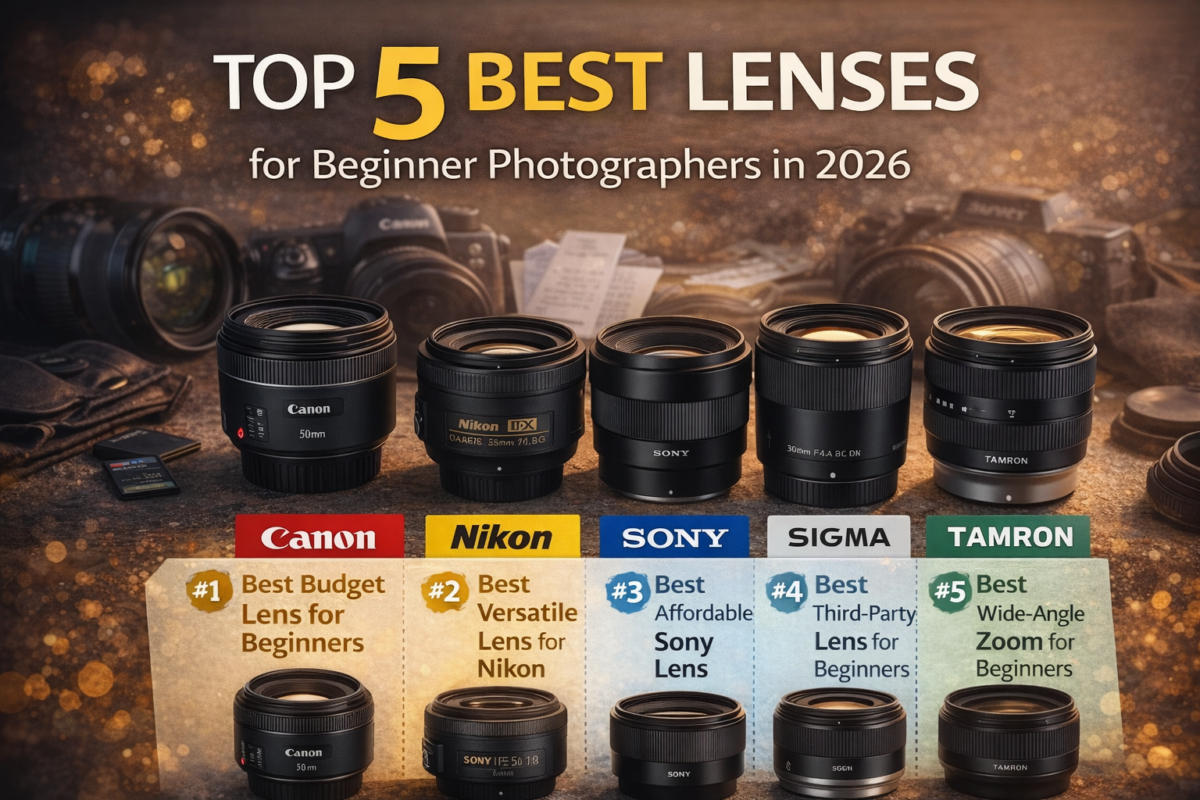
Choosing the best lenses for beginner photographers can feel overwhelming when you’re faced with hundreds of options across Canon, Nikon, Sony, and third-party brands. In 2026, the best lenses for beginner photographers deliver sharp image quality, fast autofocus, and wide apertures — all without breaking the bank. This guide breaks down the top five lenses every new photographer should consider, explains what focal length and aperture actually mean, and helps you pick the right glass for your shooting style.
Whether you’re drawn to portrait photography, landscape shooting, or street photography, the best lenses for beginner photographers will accelerate your learning curve and produce images you’re proud to share. We’ve tested these lenses across real-world conditions to bring you honest, practical recommendations.

Table of Contents
What Makes a Lens Great for Beginners?
Before diving into specific models, it’s important to understand what separates the best lenses for beginner photographers from professional-grade glass. Two specifications matter most: focal length and aperture.
Focal length determines how wide or narrow your field of view is. A 35mm lens captures a wide scene, making it ideal for street and environmental photography. A 50mm lens closely mimics how the human eye sees, which is why it’s considered the classic portrait focal length. Wider lenses in the 17-28mm range are perfect for landscapes and architecture.
Aperture, measured in f-stops, controls how much light enters the lens. Lower numbers like f/1.4 or f/1.8 let in more light, which means better low-light performance and that beautiful blurred background (bokeh) you see in professional portraits. As a result, lenses with wider apertures tend to cost more — but the best lenses for beginner photographers hit a sweet spot between bright apertures and affordable pricing.
Prime vs. Zoom Lenses: Which Should Beginners Choose?
One of the first decisions new photographers face is choosing between prime and zoom lenses. Understanding this distinction helps you select the best lenses for beginner photographers based on your specific needs.
Prime lenses have a fixed focal length, meaning you physically move closer or farther from your subject to compose a shot. This limitation is actually a strength for beginners — it forces you to think about composition and develop your creative eye. Additionally, prime lenses deliver sharper images, wider apertures, and lighter weight at lower price points.
Zoom lenses cover a range of focal lengths in a single lens. For example, the Tamron 17-28mm lets you shoot wide landscapes and tighter compositions without swapping glass. However, zoom lenses are typically heavier, more expensive, and slightly less sharp than primes at equivalent focal lengths.
For most beginners, starting with one quality prime lens alongside your camera’s kit lens is the most cost-effective path to better photography. Once you’ve mastered composition fundamentals, adding a zoom lens expands your creative versatility.
Top 5 Best Lenses for Beginner Photographers in 2026
We’ve selected the best lenses for beginner photographers across Canon, Nikon, Sony, and third-party systems. Each lens was evaluated on image quality, build quality, autofocus speed, and overall value for money.
1. Canon EF 50mm f/1.8 STM — Best Budget Lens for Beginners
Canon EF 50mm f/1.8 STM
- Most affordable prime lens for Canon beginner photographers
- Exceptionally sharp portraits with creamy f/1.8 bokeh
- Fast STM autofocus — smooth and nearly silent
- Weighs only 160g — ultra-lightweight for all-day shooting
Often called the “nifty fifty,” the Canon EF 50mm f/1.8 STM is widely regarded as the single best lens for beginner photographers on the Canon system. At typically under $125, it offers remarkable image quality for its price. The f/1.8 aperture produces beautiful background blur for portraits and handles low-light environments with ease. Furthermore, its compact 160g body makes it easy to carry everywhere.
2. Nikon AF-S 35mm f/1.8G DX — Best Versatile Lens for Nikon Beginners
Nikon AF-S 35mm f/1.8G DX
- Top-rated versatile lens for Nikon beginner photographers
- 35mm focal length suits portraits, street, and travel
- Silent Wave Motor for fast, quiet autofocus
- Excellent sharpness at a budget-friendly price point
The Nikon AF-S 35mm f/1.8G DX is one of the best lenses for beginner photographers who shoot with Nikon DX-format cameras. The 35mm focal length on a crop sensor gives an effective 52.5mm field of view, making it incredibly versatile for portraits, street photography, and everyday shooting. Its Silent Wave Motor delivers fast, quiet autofocus that also works beautifully for video. At around $200, it’s an outstanding value for Nikon users.
3. Sony FE 50mm f/1.8 — Best Affordable Sony Lens for Beginners
Sony FE 50mm f/1.8
- Best affordable full-frame lens for Sony beginner photographers
- Sharp autofocus with accurate subject tracking
- Lightweight 186g design perfect for mirrorless bodies
- Outstanding color rendering and smooth bokeh
Sony shooters looking for the best lenses for beginner photographers should start with the FE 50mm f/1.8. This full-frame compatible lens delivers sharp images with excellent color accuracy and pleasing bokeh. At just 186g, it pairs perfectly with Sony’s compact mirrorless bodies without adding unwanted bulk. It’s also one of the most affordable ways to experience full-frame image quality on the Sony E-mount system.
4. Sigma 30mm f/1.4 DC DN Contemporary — Best Third-Party Lens for Beginners
Sigma 30mm f/1.4 DC DN Contemporary
- Brightest aperture among the best beginner photographer lenses
- Ultra-fast f/1.4 for stunning depth of field control
- Available for Sony E, Micro Four Thirds, and L-mount
- Exceptional optical quality rivaling lenses twice the price
The Sigma 30mm f/1.4 DC DN Contemporary stands out among the best lenses for beginner photographers who want maximum creative control over depth of field. Its ultra-bright f/1.4 aperture produces dramatically blurred backgrounds that rival much more expensive glass. Moreover, this lens is available for multiple camera systems, including Sony E-mount and Micro Four Thirds, making it accessible to a wide range of shooters. The optical quality is outstanding for a mid-range price.
5. Tamron 17-28mm f/2.8 Di III RXD — Best Wide-Angle Zoom for Beginners
Tamron 17-28mm f/2.8 Di III RXD
- Best wide-angle zoom among beginner photographer lenses
- Constant f/2.8 aperture across entire zoom range
- Outstanding sharpness for landscapes and architecture
- Compact and lightweight for a professional-grade zoom
If landscape or architectural photography excites you, the Tamron 17-28mm f/2.8 Di III RXD belongs on your shortlist of best lenses for beginner photographers. Its constant f/2.8 aperture maintains consistent exposure and depth of field throughout the zoom range — a feature typically found only in professional-tier glass. Despite its pro-level performance, this lens remains compact and lightweight at just 420g, making it an excellent travel companion.
Best Lenses for Beginner Photographers: Side-by-Side Comparison
This comparison table summarizes the key specs of each lens to help you find the best lenses for beginner photographers at a glance:
| Lens | Focal Length | Max Aperture | Weight | Best For | Price Range |
|---|---|---|---|---|---|
| Canon 50mm f/1.8 STM | 50mm | f/1.8 | 160g | Portraits & Low Light | ~$125 |
| Nikon 35mm f/1.8G DX | 35mm | f/1.8 | 200g | Versatile All-Around | ~$200 |
| Sony 50mm f/1.8 | 50mm | f/1.8 | 186g | Portraits & Bokeh | ~$250 |
| Sigma 30mm f/1.4 DN | 30mm | f/1.4 | 265g | Creative Depth of Field | ~$290 |
| Tamron 17-28mm f/2.8 | 17-28mm | f/2.8 | 420g | Landscapes & Architecture | ~$800 |
How to Choose the Best Lens Based on Your Photography Style
Selecting from the best lenses for beginner photographers becomes much easier when you match the lens to your primary interest. Here’s a breakdown by shooting style:
Portrait photographers should prioritize 50mm or 85mm prime lenses with f/1.8 apertures or wider. The Canon 50mm f/1.8 and Sony FE 50mm f/1.8 both deliver flattering subject isolation with beautifully blurred backgrounds. On crop-sensor cameras, a 35mm lens like the Nikon 35mm f/1.8G DX produces a similar field of view.
Landscape photographers need wider focal lengths to capture expansive scenes. The Tamron 17-28mm f/2.8 is the clear choice here, offering professional-grade wide-angle coverage with a constant bright aperture. Its sharp corner-to-corner performance ensures your landscapes look crisp from edge to edge.
Street photographers typically prefer 35mm focal lengths for their natural perspective and ability to capture subjects in context. The Nikon 35mm f/1.8G DX and Sigma 30mm f/1.4 DC DN are both excellent street shooting companions.
Essential Lens Care Tips for Beginner Photographers
Once you’ve invested in the best lenses for beginner photographers, protecting your equipment is essential. First, always attach a UV filter to the front element — it shields the glass from scratches and dust without affecting image quality. In addition, invest in a proper lens cleaning kit with a microfiber cloth and lens cleaning solution.
Store your lenses in a padded camera bag when not in use, and always use front and rear lens caps during transport. Avoid touching the glass elements with your fingers, as oils can degrade coatings over time. With proper care, these lenses will serve you well for years as your skills develop.
To maximize your creative potential, practice shooting in aperture priority mode. This allows you to control depth of field while the camera handles shutter speed automatically. It’s the fastest way to learn how aperture affects your images. For more photography equipment recommendations, explore our 2026 seasonal deals guide and complete camera gear roundup.
Frequently Asked Questions About the Best Lenses for Beginner Photographers
What is the best lens for beginner photographers on a tight budget?
The Canon EF 50mm f/1.8 STM is the best budget lens for beginner photographers, typically priced under $125. It delivers professional-quality portraits with creamy bokeh and sharp autofocus. For Nikon users, the AF-S 35mm f/1.8G DX offers similar value at around $200. Both are among the best lenses for beginner photographers who want excellent image quality without a large investment.
Should beginner photographers buy a prime or zoom lens first?
Most beginner photographers should start with a prime lens. Prime lenses offer sharper images, wider apertures, and lower prices compared to zoom lenses. A 50mm or 35mm prime teaches composition fundamentals and forces you to move and think creatively. Once comfortable with prime shooting, adding a zoom lens like the Tamron 17-28mm f/2.8 provides versatility without replacing your prime.
Can I use the same lens on different camera brands?
No — lenses are mount-specific to each camera brand. Canon uses EF and RF mounts, Nikon uses F-mount and Z-mount, and Sony uses E-mount. However, third-party manufacturers like Sigma and Tamron produce the same lens design for multiple mounts. Always verify mount compatibility before purchasing any of the best lenses for beginner photographers.
What focal length is best for portrait photography as a beginner?
The 50mm and 85mm focal lengths are the portrait photography standard. On crop-sensor cameras, a 35mm lens delivers a similar effective field of view to 50mm on full-frame. Both the Canon 50mm f/1.8 and Sony FE 50mm f/1.8 create flattering subject isolation with beautiful background blur at apertures of f/1.8 to f/2.8.
Do beginner photographers need image stabilization in their lenses?
Image stabilization is helpful but not essential for beginner photographers. Most of the best lenses for beginner photographers — including the Canon 50mm f/1.8 and Sigma 30mm f/1.4 — lack optical stabilization yet still produce sharp images. Their wide apertures allow fast shutter speeds that minimize camera shake. Stabilization becomes more important with telephoto and zoom lenses where shake is amplified.
What is the difference between full-frame and crop-sensor lenses?
Full-frame lenses are designed for larger camera sensors, while crop-sensor (APS-C or DX) lenses are built for smaller sensors. Crop-sensor lenses like the Nikon 35mm f/1.8G DX are lighter and cheaper but cannot cover a full-frame sensor. Full-frame lenses like the Sony FE 50mm f/1.8 work on both sensor types, making them a future-proof investment for beginner photographers planning to upgrade.
The best lenses for beginner photographers in 2026 combine sharp optics, bright apertures, and beginner-friendly pricing. Whether you choose the Canon 50mm f/1.8 for its unbeatable value, the Nikon 35mm f/1.8G for its versatility, or the Sigma 30mm f/1.4 for its creative depth of field control, each lens on this list will dramatically improve your photography. Start with one quality lens, practice consistently, and expand your collection as your skills and creative vision evolve.