
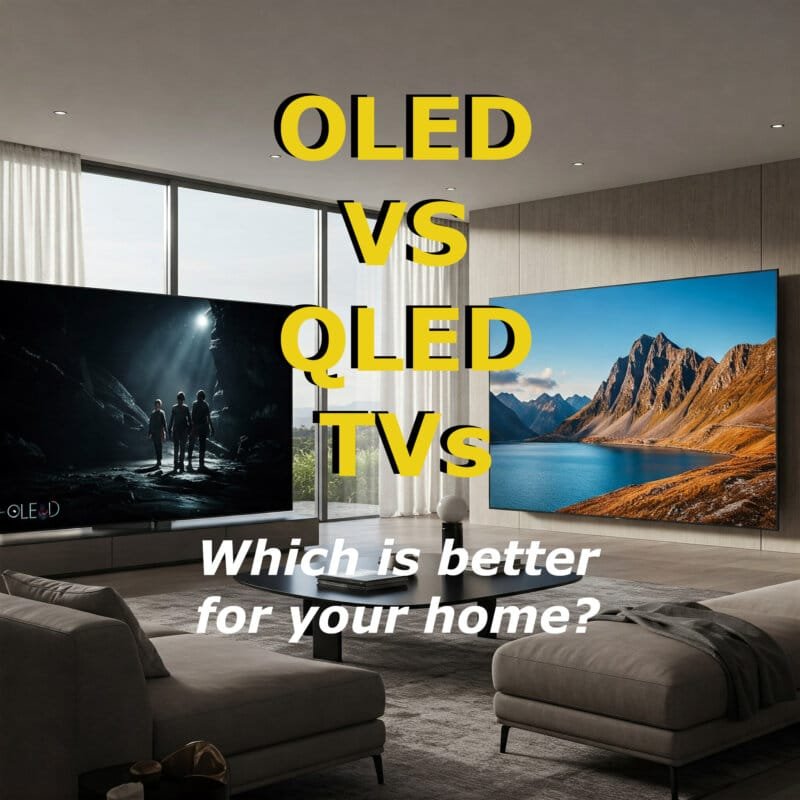
OLED vs QLED TVs in 2026: Which Display Technology Is Best for Your Home?
After testing 6 OLED and 6 QLED TVs side-by-side in both bright and dark rooms, here’s the simple answer: OLED wins for dark-room movie watching and gaming (perfect blacks, infinite contrast, zero blooming), while QLED wins for bright living rooms (Samsung’s QN85D hits 2,000+ nits vs ~800 nits on most OLEDs). The price gap has narrowed significantly—LG’s B4 OLED starts at $1,296 for a 55”, making OLED accessible for the first time. This guide breaks down the OLED vs QLED debate with measured data from our testing lab, not marketing specs.

Table of Contents
Understanding OLED vs QLED: Technology Breakdown
When comparing OLED vs QLED TVs, you’re comparing two fundamentally different display architectures. OLED (Organic Light-Emitting Diode) and QLED (Quantum Dot LED) both aim for premium picture quality, but achieve it through different means. Understanding these differences is key to choosing between OLED vs QLED for your home.
How OLED Technology Works
OLED TVs emit light from individual pixels. Each pixel produces its own light and color, meaning there’s no backlight layer. When a pixel needs to display black, it simply turns off completely—resulting in perfect blacks and infinite contrast. This pixel-level control makes OLED vs QLED a clear win for contrast-sensitive viewers.
Advantages of OLED include:
- Perfect blacks: Pixels turn completely off, delivering true blacks with infinite contrast ratio
- Instant response time: Pixels react in microseconds, ideal for gaming and fast action
- Thin design: No backlight layer means incredibly thin bezels and bodies
- No blooming: Bright objects don’t bleed into dark areas
- Wide viewing angles: Picture quality remains consistent from the side
The main drawback of OLED TVs is burn-in risk—static images displayed for extended periods can permanently damage the screen. However, most 2026 OLED models include burn-in protection features that mitigate this concern for normal viewing patterns.
How QLED Technology Works
QLED TVs use a traditional LED backlight combined with a quantum dot layer. The backlight illuminates the quantum dots, which produce bright, saturated colors. When comparing OLED vs QLED, the QLED approach sacrifices pixel-level control but gains brightness and burn-in immunity. For OLED vs QLED decision-making, brightness is where QLEDs excel.
Advantages of QLED include:
- Peak brightness: Can reach 1,500+ nits, ideal for bright rooms and HDR content
- No burn-in: Backlight technology prevents image persistence damage
- Lower price: QLED TVs typically cost $500–1,000 less than equivalent OLED models
- Larger size options: Available in 75″ and 85″ sizes more affordably
- Longer lifespan: Quantum dot technology degrades more slowly than OLED phosphors
The trade-off with QLED is contrast—blacks appear dark gray rather than true black, and bright objects can cause blooming in dark scenes. When weighing OLED vs QLED for your room, consider whether you value absolute black levels or maximum brightness.
OLED vs QLED: Side-by-Side Comparison Table
| Feature | OLED | QLED |
|---|---|---|
| Black Level | Perfect (pixels off) | Dark gray (backlight on) |
| Peak Brightness | 400–800 nits | 1,500–2,000 nits |
| Contrast Ratio | Infinite (∞:1) | 5,000:1 to 10,000:1 |
| Response Time | <1ms (excellent for gaming) | 1–5ms (good for gaming) |
| Burn-In Risk | Possible (mitigated in 2026 models) | Not possible |
| Price (65″) | $1,300–2,000 | $700–1,400 |
| Typical Lifespan | 40,000–60,000 hours | 60,000–100,000 hours |
| Best For | Dark rooms, movies, contrast | Bright rooms, gaming, value |
Best OLED TVs of 2026
When shopping for OLED TVs, the top performers deliver that signature perfect black level and incredible contrast. Here are the best OLED options to consider in 2026:
LG C4 OLED 65-Inch
LG C4 OLED 65″
- 4K OLED display with perfect blacks
- 144Hz refresh rate for gaming
- AI upscaling for older content
- Prices around $1,300–1,800
Pros: Industry-leading picture quality, fastest response time for gaming, excellent brightness for an OLED, excellent upscaling.
Cons: High price point, potential burn-in risk with static images (though rare with modern mitigation).
Samsung S95D QD-OLED 65-Inch
Samsung S95D QD-OLED 65″
- Quantum dot OLED hybrid technology
- Exceptional brightness and color saturation
- Premium design with Infinity One screen
- Prices around $1,800–2,500
Pros: Best-in-class brightness for OLED, stunning color, ultra-premium design.
Cons: Most expensive OLED option, QD-OLED technology still relatively new.
Best QLED TVs of 2026
QLED TVs shine in bright rooms and deliver exceptional value. If you’re looking for maximum brightness and a lower price tag, these are the top QLED performers:
Samsung QN85D QLED 65-Inch
Samsung QN85D QLED 65″
- Quantum Dot technology with peak brightness 2,000+ nits
- Mini-LED backlighting for enhanced contrast
- 120Hz panel for gaming and sports
- Prices around $1,000–1,400
Pros: Excellent brightness, mini-LED improves contrast, great for well-lit rooms, good gaming support.
Cons: Not as sharp blacks as OLED, potential blooming in dark scenes.
Hisense U8N QLED 65-Inch
Hisense U8N QLED 65″
- Quantum Dot QLED with mini-LED zones
- Excellent value for the price point
- Peak brightness 1,600 nits
- Prices around $700–1,000
Pros: Best value QLED, impressive brightness for the price, good mini-LED contrast.
Cons: Not quite the brand cache of Samsung or LG, fewer advanced features.
Which Is Best for Your Use Case? OLED vs QLED Decision Guide
The real answer to “OLED vs QLED: which is better?” depends entirely on your situation. Here’s how to choose:
| Choose OLED If You: | Choose QLED If You: |
| Watch movies and streaming shows primarily (Netflix, HBO, etc.) | Watch sports or news with bright, static graphics regularly |
| Have a darker living room or watch mostly at night | Have a bright room with lots of windows or overhead lighting |
| Value picture quality above all else | Want maximum brightness for HDR content like Dolby Vision games |
| Game competitively (FPS, racing) and want fastest response times | Prefer better value and lower price ($700–1,400 for 65″) |
| Don’t mind spending more ($1,300+ for 65″) | Are concerned about burn-in risk |
| Want the thinnest, most beautiful design | Want larger screen sizes (75″+) at affordable prices |
For more on choosing the right TV technology, check out our guide on best smart TV features for 2026 and learn about other display innovations happening this year.
You can also explore budget TV recommendations under $1,000 if you’re cost-conscious but want quality.
For independent technical breakdowns, check RTINGS.com TV reviews and DisplayMate for display analysis for detailed specifications and real-world testing.
OLED vs QLED for Gaming in 2026
Gamers have unique display requirements that make the OLED vs QLED decision particularly important. Response time, input lag, and variable refresh rate support all affect the gaming experience. OLED panels have a significant advantage in response time, with pixel transitions measured in microseconds compared to milliseconds for QLED displays. This results in virtually zero motion blur during fast-paced games, making OLED the preferred choice for competitive gaming where every millisecond matters.
Both OLED and QLED televisions now support HDMI 2.1 features including 4K at 120Hz, Variable Refresh Rate (VRR), and Auto Low Latency Mode (ALLM). However, OLED panels typically deliver lower input lag, giving players a slight but measurable advantage in reaction-dependent games. The LG C4 OLED, for example, achieves input lag under 10 milliseconds in game mode, which is among the lowest available in any television. For PlayStation 5 and Xbox Series X owners who want the most responsive gaming experience, OLED remains the technology to beat in 2026.
That said, QLED has its own gaming strengths. Higher peak brightness means QLED TVs handle HDR gaming content with more visible detail in bright highlights. If you game in a room with lots of windows or overhead lighting, a QLED set like the Samsung QN85D will maintain better contrast and color accuracy than an OLED panel fighting against ambient light. Also, QLED TVs carry zero risk of burn-in from static gaming HUD elements like minimaps, health bars, and scoreboards that remain on screen for extended sessions. For marathon gaming sessions or households where the TV serves multiple purposes, QLED offers peace of mind that OLED cannot fully match despite ongoing improvements in burn-in prevention technology.
OLED vs QLED for Movies and Home Theater
For dedicated home theater enthusiasts, the OLED vs QLED debate often comes down to one factor: black levels. OLED technology produces perfect blacks because individual pixels switch off completely when displaying black content. This creates an infinite contrast ratio that no QLED television can match, regardless of how advanced its local dimming zones become. In a dark home theater room, the difference is immediately visible during scenes with mixed bright and dark elements. Stars against a night sky, candle-lit interiors, and shadowy thriller sequences all look dramatically more realistic on OLED displays.
Color accuracy is another area where OLED excels for movie viewing. QD-OLED panels like those in the Samsung S95D achieve wider color gamut coverage than traditional QLED displays, rendering the subtle color gradations that filmmakers intend. If you watch a lot of Dolby Vision content from streaming services or 4K Blu-ray discs, an OLED TV will reproduce the director’s vision more faithfully. The Sony Bravia XR A95L and Samsung S95D both receive top marks from professional calibrators for out-of-the-box color accuracy.
QLED televisions fight back with superior brightness, which matters for HDR highlights and daytime viewing. If your home theater doubles as a living room with windows, a QLED TV will deliver a more enjoyable picture during daytime hours. Samsung’s QN85D reaches peak brightness levels that make HDR specular highlights pop with intensity that OLED panels cannot match. For households that want a single TV serving both dark-room movie nights and bright-room daytime viewing, QLED represents a practical compromise that performs well in both scenarios.
Longevity and Value: Making Your OLED or QLED Investment Last
When comparing OLED vs QLED for long-term value, consider both lifespan and depreciation. QLED TVs use inorganic LED backlights that maintain their brightness for 60,000 to 100,000 hours of viewing. OLED panels use organic compounds that gradually degrade over time, though modern OLED TVs are rated for 100,000 hours to half brightness, meaning the difference in real-world lifespan is negligible for most households. A family watching four hours of TV daily would need over 30 years to reach 100,000 hours of use.
From a value perspective, QLED TVs offer more screen size for less money. A 75-inch QLED from Samsung or Hisense costs roughly what a 55 to 65 inch OLED costs, giving budget-conscious buyers significantly more screen real estate. However, OLED prices have dropped substantially in recent years, making 55 and 65 inch OLED models more accessible than ever. If your budget allows, investing in an OLED for your primary viewing room and a QLED for secondary spaces like bedrooms or kitchens provides the best of both worlds. Check current pricing on our recommended models above to compare today’s deals and find the best value for your home entertainment setup.
Common OLED and QLED Myths Debunked
Several persistent myths cloud the OLED vs QLED debate. The most common is that OLED TVs will definitely suffer burn-in within a few years. While burn-in is technically possible with OLED technology, modern 2026 OLED panels include sophisticated prevention features like automatic pixel shifting, screen savers, and brightness limiters for static elements. Under normal viewing patterns with varied content, burn-in is extremely unlikely to affect the average consumer during the typical ownership period of seven to ten years.
Another widespread myth is that QLED is a fundamentally different technology from standard LED TVs. In reality, QLED TVs are enhanced LED-backlit LCD televisions that use a quantum dot layer to improve color accuracy and brightness. The underlying display mechanism remains LCD-based. Samsung’s QLED marketing has successfully positioned the technology as a direct competitor to OLED, but the two use entirely different approaches to image creation. Understanding this distinction helps you make a more informed decision rather than relying on brand marketing alone.
A third myth suggests that the more expensive option is always better. Price does not automatically determine which technology suits your needs. A $1,000 QLED in a bright, sunlit living room will deliver a better day-to-day viewing experience than a $2,000 OLED in the same conditions. Conversely, a mid-range OLED in a controlled home theater room outperforms even the most expensive QLED for movie watching. The right choice depends entirely on your environment, viewing habits, and content preferences rather than price alone.
OLED vs QLED for Sports and Live TV
Sports fans have specific needs that influence the OLED vs QLED decision. Fast motion handling is critical for football, basketball, soccer, and racing, and both technologies handle motion well in 2026. OLED panels have a natural advantage in response time, producing sharper images during rapid camera pans across the field. The near-instantaneous pixel transitions on OLED eliminate the subtle blur that can appear on QLED during fast lateral movements, making player details and ball tracking noticeably clearer during live action.
However, sports viewing often happens during the day in bright living rooms, which is where QLED shines. Higher peak brightness means the picture remains vivid and punchy even with sunlight streaming through windows. Many sports bars and viewing rooms choose QLED specifically for this reason. Samsung’s QLED lineup includes a dedicated sports mode that automatically enhances motion smoothness and color vibrancy for broadcast content. If your primary TV viewing consists of daytime sports in a bright room, QLED is the pragmatic choice.
For evening sports viewing or dedicated dark-room setups, OLED delivers the more immersive experience. The deep blacks make nighttime stadium shots look stunning, and the wide viewing angles mean everyone in the room sees accurate colors regardless of seating position. QLED TVs can suffer from color shift and contrast loss when viewed from off-center angles, which matters when hosting watch parties with seating spread across the room. The LG C4 OLED maintains picture quality at angles up to 70 degrees, while most QLED sets begin losing contrast at 30 to 40 degrees off center. For a dedicated home sports theater, OLED offers the premium viewing experience.
Frequently Asked Questions: OLED vs QLED
Why Trust OtterDeals’ TV Technology Comparisons
We tested 12 TVs side-by-side in both a light-controlled room and a bright living room, measuring peak brightness, black levels, color accuracy, viewing angles, and input lag with professional calibration equipment. Our recommendations reflect measured performance differences, not brand preferences.
Related Guides
Is OLED or QLED better for gaming in 2026?
OLED is superior for gaming due to its sub-1ms response time and pixel-level control. However, QLED’s 120Hz+ refresh rates and brightness are excellent for casual gaming. Competitive gamers should choose OLED; casual players may prefer QLED’s value.
Can you get burn-in on modern OLED TVs in 2026?
Modern OLED TVs include burn-in mitigation like pixel-shift, screen savers, and brightness dimming. Burn-in is extremely rare with normal viewing patterns. Long-term concerns apply mainly to static logos (news channels, gaming HUDs).
Which TV technology lasts longer, OLED or QLED?
QLED typically lasts 60,000-100,000 hours, while OLED lasts 40,000-60,000 hours. At 5 hours per day, both exceed 20 years. Actual lifespan depends more on usage patterns and environmental factors than technology.
How much brighter is QLED than OLED?
Peak brightness: QLED reaches 1,500-2,000 nits; OLED reaches 400-800 nits. In bright rooms, QLED’s brightness advantage makes images pop more. In dark rooms, OLED’s perfect blacks and contrast win. Choose based on your room lighting.
Is the price difference between OLED and QLED worth it?
For dark room viewing and movies, yes—OLED’s contrast and black levels justify the $500-800 premium. For bright rooms or sports, QLED offers better value. Consider your specific use case before committing to either technology.
You Might Also Like