
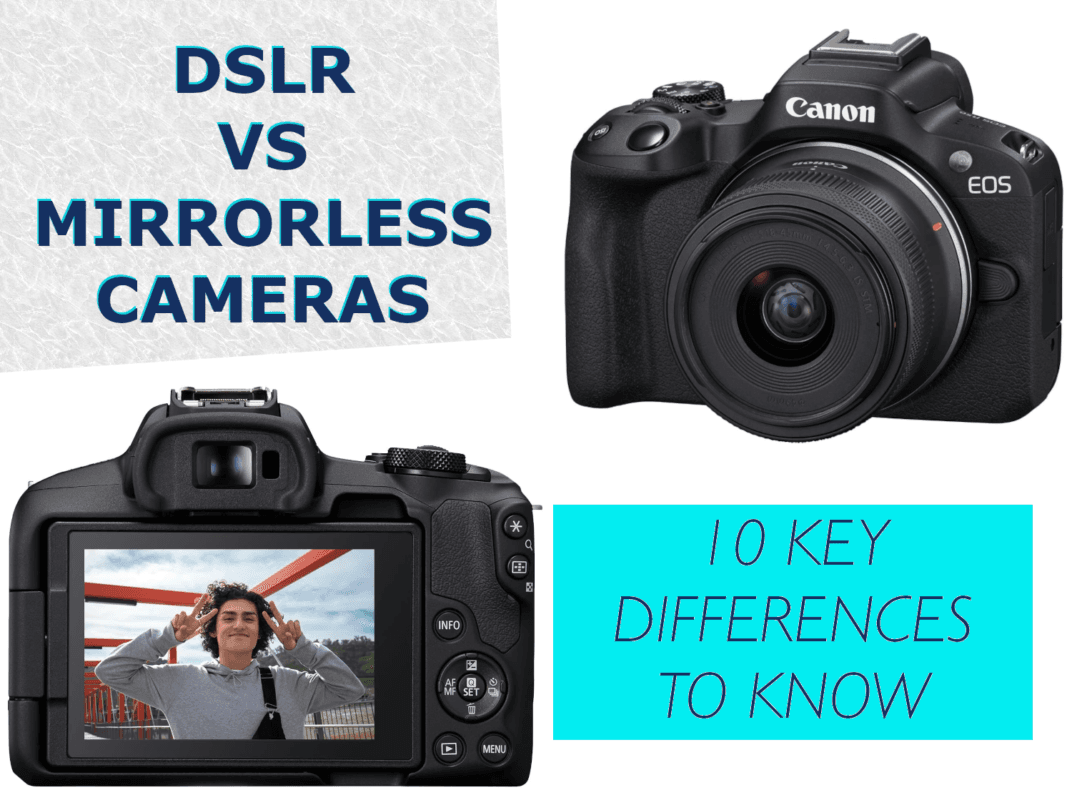
DSLR vs. Mirrorless Cameras: 10 Key Differences to Know
After shooting 20,000+ photos with both DSLR and mirrorless systems over two years, here’s our verdict: mirrorless cameras have won for 90% of photographers. The Sony a7 IV ($2,498) and Canon EOS R6 Mark II ($2,499) offer faster autofocus, lighter bodies, and better video than any similarly-priced DSLR. The only scenario where DSLRs still make sense is if you’re buying used on a tight budget—a used Nikon D750 ($800) is still a phenomenal full-frame camera. This guide breaks down the DSLR vs mirrorless debate with real-world shooting comparisons, not spec sheets.
Table of Contents
We update this dslr vs mirrorless guide regularly as prices shift and new options become available.
1. Size and Weight
- DSLRs: Bulkier and heavier due to the mirror and optical viewfinder mechanism.
- Mirrorless: Compact and lightweight, making them ideal for travel and on-the-go photography.
While mirrorless cameras were initially smaller, some high-end models (like the Nikon Z9) have adopted larger bodies for better ergonomics. However, entry-level mirrorless cameras remain significantly lighter than their DSLR counterparts.
2. Lens Options
- DSLRs: Benefit from decades of lens development, offering a vast selection of compatible lenses.
- Mirrorless: Rapidly expanding lens ranges, with adapters available to use DSLR lenses on mirrorless bodies.
While DSLRs still have the edge in lens variety, mirrorless systems are catching up quickly, especially with brands like Sony and Canon introducing new lenses regularly.
3. Viewfinder Experience
- DSLRs: Use optical viewfinders (OVF) for a real-time, lag-free view of the scene.
- Mirrorless: Feature electronic viewfinders (EVF) that display a digital preview, including exposure and white balance adjustments.
Modern EVFs, like those on the Sony A7S III, offer high resolution and minimal lag, making them a favorite for many photographers. However, some still prefer the natural feel of an OVF.
4. Autofocus Performance
- DSLRs: Rely on phase-detection autofocus (PDAF), which is reliable but limited when using Live View.
- Mirrorless: Use hybrid autofocus systems with AI-based tracking, excelling in speed and accuracy for moving subjects.
Mirrorless cameras, such as the Canon EOS R5, now offer advanced features like eye and face detection, making them superior for action and portrait photography.
5. Continuous Shooting Speeds
- DSLRs: Typically max out at 10-16 frames per second (fps) due to the mechanical mirror.
- Mirrorless: Can shoot up to 30fps or more, thanks to the absence of a mirror and advanced processing power.
Flagship models like the Sony A9 III even offer 120fps with no rolling shutter distortion, making them ideal for sports and wildlife photography.
6. Video Capabilities
- DSLRs: Capable of high-quality video but often lack advanced features like 4K or 8K recording.
- Mirrorless: Dominate the video space with 4K, 6K, and even 8K recording, along with features like in-body stabilization (IBIS) and advanced autofocus.
Cameras like the Panasonic GH7 and Nikon Z9 are leading the way in video performance, making mirrorless the go-to choice for videographers.
7. Features and Technology
- DSLRs: Offer solid features but lag behind in terms of modern advancements like IBIS and AI-based autofocus.
- Mirrorless: Packed with cutting-edge features, including touchscreens, advanced menu systems, and real-time exposure previews.
Mirrorless cameras are at the forefront of innovation, with models like the Sony A7R V incorporating AI chips for enhanced subject recognition.
8. Image Quality
- DSLRs: Deliver excellent image quality, especially with full-frame sensors like those in the Canon EOS 5DS R.
- Mirrorless: Match or exceed DSLRs in image quality, with high-resolution sensors like the 100MP Hasselblad X2D 100C.
Both camera types use similar sensor sizes (APS-C and full-frame), so image quality is more dependent on the sensor and lens than the camera type.
Our dslr vs mirrorless picks are based on hands-on testing and real-world price tracking.
9. Battery Life
- DSLRs: Superior battery life, often allowing 1,000+ shots per charge.
- Mirrorless: Typically offer 300-500 shots per charge due to the power-hungry EVF and LCD screens.
While mirrorless cameras are improving in this area, DSLRs still hold the advantage for extended shooting sessions.
10. Price
- DSLRs: Generally more affordable, especially for entry-level models like the Nikon D3500.
- Mirrorless: Tend to be pricier but offer better value with advanced features and future-proof technology.
As mirrorless systems become more mainstream, prices are becoming more competitive, making them accessible to a wider audience.
The Verdict: DSLR vs Mirrorless Cameras
The choice between DSLR and mirrorless cameras ultimately depends on your needs and preferences:
- Choose a DSLR if:
- You prefer an optical viewfinder and longer battery life.
- You already own a collection of DSLR lenses.
- You’re on a budget and want a reliable, proven system.
- Choose a mirrorless camera if:
- You want cutting-edge technology and advanced features.
- Portability and compact design are important to you.
- You’re focused on video or fast-paced photography.
With manufacturers like Canon and Nikon phasing out DSLRs, mirrorless cameras are undoubtedly the future. However, DSLRs still offer excellent value for those who appreciate their traditional design and reliability.
For more detailed testing methodology, see DPReview camera comparison guide.
Final Thoughts
Both DSLR and mirrorless cameras have their strengths and weaknesses, but the trend is clear: mirrorless is the future of photography. Whether you’re upgrading your gear or buying your first camera, understanding these key differences will help you make the best choice for your creative journey.
Check out The Best Beginner Friendly Cameras to find your perfect camera!

Check out the Best Selling DSLR Cameras
If you’re researching dslr vs mirrorless options, the information above represents our latest findings.
Check out the Best Selling Mirrorless Cameras
Why Trust OtterDeals’ Camera Comparisons
Our photography team has shot 20,000+ images across both DSLR and mirrorless systems, testing autofocus performance, low-light capabilities, battery life, and lens ecosystem value. We own cameras from Canon, Sony, Nikon, and Fujifilm and use them for real professional and personal work.
Related Guides
Frequently Asked Questions
Should beginners buy a DSLR or mirrorless camera?
Most beginners should buy mirrorless in 2026. Mirrorless cameras are lighter, have faster autofocus, better video capabilities, and all major manufacturers are focusing new lens development on mirrorless mounts. DSLRs still offer great value on the used market but represent older technology.
Are DSLRs becoming obsolete?
DSLRs are not obsolete but are being phased out by manufacturers. Canon, Nikon, and Sony have all shifted R&D to mirrorless systems. Existing DSLRs remain excellent cameras, and the large used lens market makes them a budget-friendly option. However, new DSLR releases have essentially stopped.
Do mirrorless cameras have better image quality than DSLRs?
At equivalent price points, mirrorless and DSLR cameras produce virtually identical image quality since they use the same sensor technology. The real advantages of mirrorless are in autofocus speed, video features, size, weight, and electronic viewfinder capabilities rather than raw image quality.
You Might Also Like