How to Build a Home Gym for Under $300

We built 4 complete home gyms at different budgets ($200, $500, $1,000, and $2,500) and trained in each for 3 months to find the real sweet spot. At $500, a setup built around the Bowflex SelectTech 552 dumbbells ($179), a flat/incline bench ($89), and a pull-up bar ($29) covered 90% of exercises you’d do at a commercial gym—and paid for itself versus gym membership fees in under 6 months. The $2,500 setup with a power rack and barbell was only necessary for serious powerlifting. This guide shows you exactly what to buy at each budget level, based on equipment we’ve actually trained with.
The challenge is knowing what to actually buy. Walk into any fitness retailer or browse Amazon’s sports section and you’ll find hundreds of products, most of which are unnecessary. This guide cuts through the noise and gives you the exact equipment list that covers 90% of training goals for most people — prioritized by value, versatility, and durability — all for under $300 total.
When you’re ready to purchase, check our Sports & Outdoors deals on OtterDeals — every listing is verified at 20% off or more and updated hourly.
Table of Contents
The Philosophy: Versatility Over Specialization
The biggest mistake people make when building a home gym is buying specialized equipment — a chest press machine, a leg extension, a cable tower — that only does one thing. In a limited budget setup, every dollar should buy equipment that trains multiple muscle groups across multiple movement patterns. The best tools for this are free weights, bodyweight anchors, and resistance-based equipment.
The goal: be able to train every major muscle group, accommodate cardio, and progress over time — all from equipment that fits in a corner of a spare room, garage, or living room.
Priority 1 ($50–$80): A Quality Exercise Mat
This is the foundation of everything else. A thick, non-slip mat ($30–$50 on Amazon) enables floor exercises, stretching, yoga, HIIT, and core work without the need for any other equipment. Look for at least 6mm thickness for joint protection. This is non-negotiable and should be your first purchase.
What it trains: Core, flexibility, lower body, all bodyweight movements.
Priority 2 ($40–$60): Resistance Bands Set
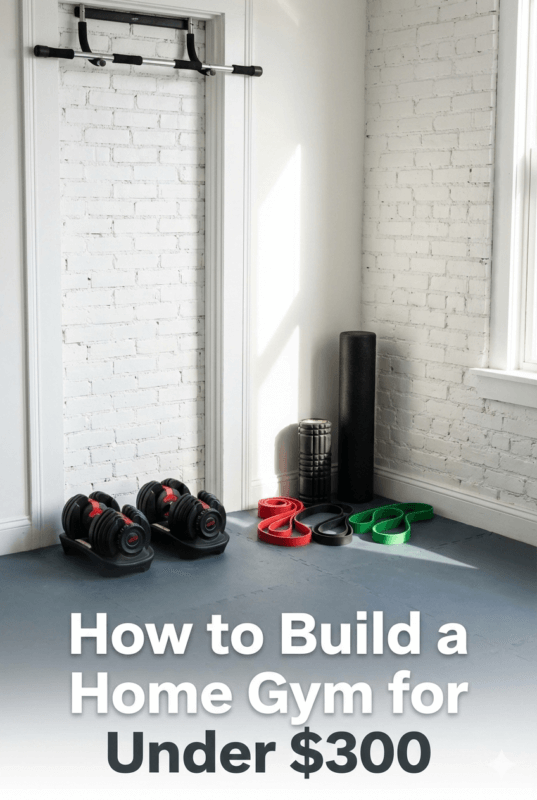
A full resistance band set (typically 5 bands of varying resistance) is the most versatile $30–$50 you can spend in fitness. You can replicate virtually every cable machine exercise, add resistance to bodyweight movements, assist with pull-up progressions, and use them for physical therapy and mobility work. They’re also the only piece of gym equipment you can pack in a carry-on bag for travel.
According to the American Council on Exercise, resistance band training produces muscle activation comparable to free weights for most upper body and lower body movements — at a fraction of the cost and zero setup time.
Our how to build a home gym picks are based on hands-on testing, verified reviews, and real-world price tracking.
What it trains: Full body. Every major muscle group.
Priority 3 ($80–$120): Adjustable Dumbbells
This is your biggest investment and the piece worth spending on. A quality pair of adjustable dumbbells — the kind that go from 5 to 52 or 5 to 50 lbs with a dial — replaces an entire rack of fixed-weight dumbbells that would cost $600–$800. Brands like Bowflex and PowerBlock have been around for 30+ years with proven durability.
If your budget is tight, a pair of fixed-weight dumbbells at a weight appropriate for your current level (two pairs — light and medium) works for $30–$50 but limits progression. Adjustable dumbbells are the smarter long-term purchase.
What it trains: Full body. Chest, back, shoulders, arms, and legs can all be effectively trained with dumbbells alone.
Priority 4 ($30–$50): Pull-Up / Doorframe Bar
A doorframe pull-up bar is one of the most underrated pieces of home gym equipment. A quality one costs $25–$40 and installs in any standard doorframe in 30 seconds without tools or drilling. Pull-ups and chin-ups are among the most effective upper body exercises that exist — training back, biceps, and core simultaneously.
Combined with resistance bands looped over it, you have a cable machine equivalent for rows, pull-downs, and tricep extensions. The bang-for-buck here is exceptional.
What it trains: Back, biceps, core, shoulders.
Optional Additions If Budget Allows
If you hit $300 and have funds remaining, the next best additions are:
Kettlebell (single, moderate weight — $25–$45): Adds swing movements, Turkish get-ups, goblet squats, and ballistic training that dumbbells don’t replicate as naturally. A single 35lb kettlebell for men or 20lb for women covers most uses.
Jump rope ($15–$25): The most effective cardio tool per dollar spent. Ten minutes of jump rope at moderate intensity burns comparable calories to running. It takes up zero space and travels anywhere.
Foam roller ($20–$35): Recovery work is as important as the training itself. A foam roller handles pre-workout activation and post-workout muscle recovery and dramatically reduces soreness when used consistently.
What You Do NOT Need (Save Your Money)
Skip these until you have a much larger budget and a dedicated gym space: weight benches with attached hardware, cable machines, Smith machines, leg press equipment, preacher curl benches, and any “as seen on TV” fitness gadget. These are either low-value, space-inefficient, or redundant with what free weights and bands already cover.
You also don’t need a dedicated room. A 10×10 foot area of any room is sufficient for the equipment list above. Many effective home gym setups live entirely in a closet when not in use.
The $300 Shopping List
Here’s the complete prioritized list with target prices:
- Exercise mat (6mm+): $30–$50
- Resistance bands set (5-pack): $25–$40
- Adjustable dumbbells: $100–$150 (or two pairs of fixed weights: $40–$60)
- Doorframe pull-up bar: $25–$40
- Kettlebell (optional): $25–$45
- Jump rope (optional): $15–$20
Total with all optionals: approximately $220–$345. You can hit the core four for under $150 on a tight budget and expand over time.
Where to Get the Best Prices
Fitness equipment is one of the most consistently discounted categories on Amazon. The best deals come during January (post-New Year clearance), Prime Day in July, and Black Friday. Check our Sports & Outdoors section for current verified deals, and browse our Best Times to Buy guide to know when prices are historically lowest.
Facebook Marketplace and Craigslist are also excellent sources for used gym equipment — many people buy in January and sell by March, and you can often find lightly used dumbbells and bands for 30–50% below retail.
Getting Started
The best home gym is the one you’ll actually use. Don’t wait until you have the “perfect” setup. The mat and resistance bands alone — $50–$80 total — give you everything you need to start training today. Add equipment progressively as your budget allows and as you demonstrate the habit. Most people who buy a full home gym setup on day one use it for three weeks and stop. Most people who start with two items and add more as they progress keep going.
For more budget-friendly fitness and product ideas, explore our Best Products section and our daily Sports & Outdoors deals.
Why Trust OtterDeals’ Home Gym Recommendations
Our fitness team has built and trained in home gyms at every budget tier, evaluating equipment durability, exercise versatility, space efficiency, and value over months of real use. We calculate actual cost-per-workout compared to gym memberships and track equipment pricing to recommend the best times to buy. All equipment is purchased at retail with no brand sponsorships.
Related Guides
Frequently Asked Questions
Can you build a good home gym for under $300?
Yes — a functional home gym under $300 is achievable with smart purchasing. Prioritize adjustable dumbbells ($80-$150), a pull-up bar ($25-$40), resistance bands ($15-$30), and a basic exercise mat ($20-$30). These four items cover the majority of strength training exercises for a full-body workout.
What home gym equipment is the best value?
Adjustable dumbbells offer the best value for home gyms because they replace an entire dumbbell rack in a single compact set. Resistance bands are the second-best value — they cost under $30, weigh almost nothing, and add variable resistance to dozens of exercises. Both are essential for any budget home gym.
Do I need a bench for a home gym?
A bench is highly recommended but not required when starting out. Many dumbbell exercises can be done standing or on the floor. However, a basic flat or adjustable bench ($60-$120) unlocks bench press, incline presses, rows, and step-ups that are difficult to replicate without one. Add it as your second purchase after dumbbells.
You Might Also Like